Writerly occupational hazards: Ersatz creativity (boozing)
Inebriation is a false Muse. As seductive as they may be, chemical substitutes for true creative intoxication don’t work.
Maybe there are exceptions that prove this rule. Malcolm Lowry, e.g., did much field research for his brilliant novel Under the Volcano, which included a main protagonist who was drinking himself to death. (Lowry, unfortunately, perhaps in his quest for verisimilitude, was himself to go all the way at an early age.) Emulating his own hard-boiled detective protagonists, writer Micky Spillane claimed he’d go to the office, get his feet up on his desk, crack a bottle of whiskey and dictate the next book off the top of his head to his (leggy) secretary. I can almost believe him, having read a couple of his stories way back when I was a boy. Though I suspect he asked his secretary to have a quick look at his punctuation, after she washed out his shot glass and ashtray and before sending the ms. to the publisher.
Generally, though, writing and boozing don’t mix.
James Joyce had this to say about matters:
Boozing does not necessarily have to go hand in hand with being a writer, as seems to be the concept in America. I therefore solemnly declare to all young men tyring to become writers that they do not actually have to become drunkards first.
Samuel Johnson, with his usual verbal parsimony, suggested this:
One of the disadvantages of wine is that it makes a man mistake words for thoughts.
What the hell. I’m moved to coin an aphorism of my own:
Our fiction-writing faculties may also produce splendid daydreams. Especially when inflamed by alcohol, these in turn conduce to celebrating one’s literary awards before they’re awarded, not to mention counting one’s groupies before they’ve hatched.
Our friend Jack Shackaway says all that’s rubbish. He tells me that boozing provides him with much literary lumber for the building. In fact, here’s something he has just passed me:
“Doctor, doctor,” I say. “I am suffering from a chronic hangover.”
“Yes,” she tells me. “That is an occupational hazard of piss artistry, and there is no cure unless you find another line of work.”
“But all I know is writing.”
“Then we can only treat the symptoms. There is no cure, although I personally find that a Bloody Mary with double vodka and a megadose of vitamins B and C on the side can work wonders.”
At this point in my dream the doctor takes to looking much younger and shapelier and she starts to remove her clothes, and I’m wondering whether this is part of the treatment, when I’m awakened by a nurse.
I see my doctor riding shotgun in the background. Then she comes forward to say, “It’s confirmed. You have dengue fever.”
Dengue fever, eh? When you’ve had as many force-10 hangovers as I’ve come up with these past months, you laugh at dengue fever. Almost.
I make a grab for the nurse, but then I wake up again, and I’m at home.
And it’s really a hangover I’m looking at after all
QED, eh? (Referring to my earlier claim re. drinking and writing.)
A last perspective, this from Philip Larkin:
Get stewed.
Books are a load of crap.
That, and the other literary quotes, aside from my own, are from Advice to Writers: A Compendium of Quotes, Anedcotes, and Writerly Wisdom from a Dazzling Array of Literary Lights, by John Winokur.
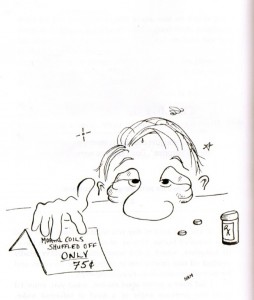
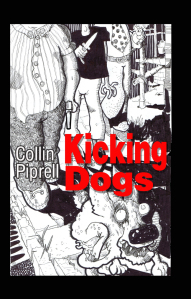
The cartoon illustration is from “The Joy of Hangovers" in Bangkok Old Hand, by Collin Piprell (out of print).
Harvest Season—better than The Beach?
In my opinion, Chris Taylor’s Harvest Season is a better story, better told, than Alex Garland’s The Beach.
I compare the two books only because each involves “backpackers” on the Asia trail. Taylor’s story unfolds in relatively remote China, whereas The Beach is set in what are supposed to be islands in the Gulf of Thailand. With Harvest Season, though, I have a much surer sense that the writer is indeed familiar with his geographical and subcultural settings. That is probably because the author is a professional travel writer with much experience in Asia.
This book, Taylor’s first novel, is very readable. The drama unfolds on the basis of a great premise. The dialogue is competent, the characters, both Western and Chinese, are intriguing and real, the settings convincing, and the background issues contemporary and interesting.
We find a mixed bag of protagonists in Shuangshan, a still fairly traditional community suffering intimations of radical change to come. On the one hand, the local ethnic population has already felt impacts from Han Chinese settlement (to some extent reflecting a deliberate policy of social and cultural homogenization). On the other hand, Shuangshan is clearly an early Khao San Road (Bangkok) or Thamel (Kathmandu) in the making.
Some of the characters, including Matt, the main protagonist, are Western travelers who see themselves as a community of exiles in search of freedom from all the bullshit back home. To make this work, they want to maintain, as much as they can, the exclusivity of their Shangri-La of choice. Others, more recent arrivals, see the situation both as a commercial opportunity and as a chance to become large frogs in this small pond. For their part, the Chinese characters include parallel representatives of all those species and more—new entrepreneurs, exiles from mainstream Chinese society in search of freedom, and local vested interests.
With a growing sense of inevitability, we see increasingly dangerous conflicts arising within and between the Western and Chinese groups.
Meanwhile the fires of the mass tourist hordes are glowing just over the horizon. The “Rough Planet” guides and their ilk have already blazed trails in the vicinity, and Shuangshan teeters on the cusp of change. Matt is a youngish traveler with an obscure past, one he’s reluctant to talk about. But we do learn that, several years earlier, he himself worked as a Rough Planet writer. Hey, someone’s going to do it anyway, right? But he left Shuangshan out of his reports, wanting to keep this particular paradise off the beaten path, all the while knowing it was futile.
The story unfolds during his second stay in Shuangshan, when the futility of this dream is being brought home with greater and greater force. “In the Shuangshan I’d returned to a year ago,” Matt says, “nobody got tattoos to celebrate their first acid trip.” Yet here was his friend Fei-Fei getting a tattoo and “now Shuangshan had marked her permanently, and she would always belong to the fringe.”
By the end of the novel, a number of the characters have been scarred and worse by other, darker developments.
Readers and characters are left with a poignant sense of loss at various levels. Already, local residents no longer recognize the community of their childhoods. And now there seems to be no avoiding catastrophic commercialization of this erstwhile hideaway for the walking wounded from a global consumerist culture.
Matt also suffers a personal sense of loss he might find hard to articulate. Against the background described above, he has pursued unsuccessful relationships with two different Chinese women. To some extent the problems are cultural in nature, but Matt is alienated from his own culture to the extent he might well have problems, at this stage, in establishing long-term relations with any woman, no matter where she’s from.
And now he’ll have to move on again.
Chris Taylor's website
Grundnorm of writing style
Dorothy Parker's opinion of the most widely recognized writing style manual in the English language:
"If you have any young friends who aspire to become writers, the second greatest favor you can do them is to present them with copies of The Elements of Style. The first greatest, of course, is to shoot them now, while they're happy."
![]()
But those who nevertheless persevere and do become writers should understand this: One cardinal principle underlies all other rules of style, including those presented by Strunk and White. The Grundnorm of style is simply this:
Make the reader’s job as easy as you can without losing anything you wish to communicate.
Basically, that in turn suggests you ensure maximum profluence. Good writers smooth out the speed bumps—they look for any problems readers might encounter before they encounter them and resolve them in advance. They get the writing out of the way of the reading. This goes some way towards defining good prose, and provides a general guide for revision and editing.
Do Strunk and White's guidelines still apply, a half-century after they first appeared in print? Mostly yes, I believe. And some recent quibbles with Strunk & White’s classic Elements of Style may miss the real point: Any rule of style, in every instance of its application, should be measured against both our Grundnorm and a corollory to this rule:
Rules of style can only be rules of thumb.
Good writers break the rules
Rules of style are maxims. They may be broken at will by competent writers. (Though competent writers will on some level recognize that they’re breaking a rule, and understand why.)
To some extent, this applies even to our Grundnorm. Just think—if writers were to apply it too rigorously, no one would ever get to read such modern classics as Infinite Jest.
For all kinds of reasons, writers may well decide they want to bring the reader up short. The essence of humor, for example, is presenting the audience with something problematic, something that appears wrong, somehow, and in its resolution evokes laughter.
Arresting the reader in mid-flow for comic effect can work. In other cases, however, we get people, many of them graduates of creative writing courses, who scatter arresting images throughout their prose, often winning big points for originality and negative scores for style. Where readers are stopping to wonder at the novelty of some turn of phrase, perhaps mentally congratulating the author, they may then need to go back and pick up the thread again. This generally suggests a failure of style.
Yet someone like David Foster Wallace routinely makes this sort of thing work. At one point in Infinite Jest, e.g., he uses “cabbage” as a transitive verb to describe a character separating a plastic garbage bag from its companions and pulling it out from under a sink. Never mind the image of someone “cabbaging” a garbage bag stopped me in my tracks, I have to concede Wallace knew what he was doing. With this book, the reader quickly grows accustomed to stopping and admiring the language, taking pleasure in the story phrase by phrase, clause by clause, page by page (for quite a considerable number of pages, in fact, including a whole lot of notes at the end of the book, some of which contain notes within notes within notes). In fact, I frequently had to re-read passages to pick up the thread again, but I didn’t mind, acknowledging that Wallace’s prose made this worthwhile.
For lesser mortals, though, such devices are normally ill-advised, no matter how accurate the expressions might appear. A book such as Infinite Jest presents a special case, where readers are already accustomed to exploring every sentence and phrase as an adventure.
Some writers ignore the rules
Then we have writers such as Hegel. He had no sense of writing style whatsoever and didn’t care. He was too busy working out the entire structure of existence—preferably, it can seem, in one sentence. Lots of people read him anyway, seduced by the intellectual adventure or maybe the need to pass a university course.
Hegel specialized in philosophical tomes. Embarking on a novel of ideas, however, is a dangerous tack for any writer to take. It makes creating real characters convincingly enmeshed in compelling dramatic situations even more difficult a task than it usually is. Thomas Mann pulled it off pretty consistently, and so did some others, though their names aren’t leaping to mind this foggy Sunday morning.
"A good writer is basically a story teller, not a scholar or a redeemer of mankind. "
In a similar vein, though I can’t find the quote, Singer has suggested somewhere else that if fiction writers set out to communicate great ideas for our age, they’ll most likely produce a bollix. If they merely sit down to write ripping good yarns, on the other hand, they may be surprised at how universal messages for humankind emerge from their stories.
So, Sara asks me, why am I writing The Proteant Enigmass? To the extent Syn, the first in a series of speculative novels, has worked (it awaits publication), that was mainly luck.
Concluding note. A gang of Eastern European philosophers once told me, in Dubrovnik as it happens, that they preferred to read Hegel in English, and to heck with the notorious impossibility of finding precise English equivalents for some of the German expressions Hegel used. To whatever extent that was true, the problem was outweighed by another consideration: professional translators actually tried to make the overall prose as intelligible as possible, and generally succeeded better than Hegel ever had.
Maybe to prove they were real philosophers, some of these heavy thinkers brought with them large unlabeled bottles of what they called Polish drink. “Is good!” they said, and it was.
I mention this anecdote only to suggest that I’m a real writer—a hairy-chested, two-fisted specimen of the old school—and to dispel disturbing and persistent rumors regarding my teetotal disposition.
Another concluding note. Re-reading the above, I see that the mere thought of Hegel has perverted my own style, and I blame him. Not that I really have to shirk responsibility, since nearly no one will read this far anyway.
Inspirational hobologoist aphorisms & epigrams
Insights into the hobologoist mindset.
Money corrupts.
Impecuniousness rools, OK!
Artists must suffer.
I have my principles.
Solipsism means never having to say you’re being corrupted by money and prizes.
I like semi-colons; commercial editors can go screw themselves.
I like [literary practice of your choice]; commercial editors can go screw themselves.
Hobologoists don’t write query letters.
Nobody ever read Antoine Blorschacterforth either.
Save the trees, save the bytes, save having to explain to critics why they are fools. Remain unreadable, unpublishable, unflappable in face of famine.
Zen hobologoism: “Why write a book that no one reads? That is the whole point.”
Taoist hobologoism: “Stuff happens. Some of it we call books. Better to contain these than let them lead to readers and critics, eh?” (Few people realize that Taoism originated in Canada.)
Chief Smokey Tent: “I write my novels on the wind; read them if you can.”
Collin Piprell: “Haiku are easier than novels, unless inscrutability is your first aim.”
Marketing model for hobologoists.
Kafka portrait by Dimitrije Popović.
Hobologoists International FAQs
What is it? Hobologoism is the principled resolve to write and write in such a way as to never, ever produce anything remotely publishable or in any way profitable.
Who are we? Hobologoists International is a global association of writers who have written at least one book that fellow members agree is clinically unpublishable under any imaginable circumstances, even taking into account revolutionary changes in contemporary commercial publishing and popular reading habits.
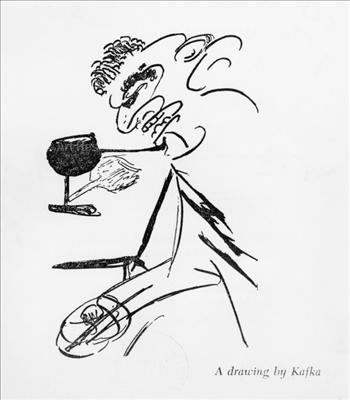
Why does our logo incorporate a portrait of Kafka? Kafka, who tried to burn his entire opus before he died, has on that ground been adopted as the patron saint of Hobologoists.
Who is Ralph the Writer? Ralph the Writer has been granted honorary sainthood on the basis of Kooba: A Book. This, Ralph’s magnum opus, was written backwards from the concluding full stop in an English approximation to an obscure Gaspésie patois with all variants of the letter “e” removed for reasons that will forever remain secret, since Ralph was killed, sadly, in a barroom brawl with a critic who somehow managed to access a copy of the manuscript and then publish favorable comment in a small right-wing literary magazine, now defunct. (The critic himself died shortly thereafter, murdered by his wife, who subsequently told the court her husband was a giant pain in the ass.)
Even more sadly, Ralph’s book otherwise came so close to going entirely unread. Rarely has a hobologoist, even the most self-consciously principled member of the Association, produced a manuscript vehemently never read even by the author’s mother. “Merde!” Ralph’s mother is reported to have said. “I can’t read this. It’s a bag of shit. Pure merde, non?”
It is that purity which elevates this work and its author to the Hobologoists International pantheon of saints.
How can I become a member? Send us your candidate manuscript (minimum 80,000 words; any language—what does it matter?), together with notarized rejections from at least 100 agents and 50 publishers. It is to your advantage if you can include abusive letters from family and friends you have asked to read this manuscript.
If your application passes our initial jury, you will be asked to submit all copies of the manuscript, both paper and digital, and watch impassively as a second jury ceremonially burns all record of your work.
Finally, in front of the same jury, before the smoke has dissipated, you must solemnly pledge yourself to writing a sequel to that book.
And Bob’s your uncle.
Photo credit/drawing by Kafka: Snark / Art Resource, NY.
Portrait of Kafka by Vavro Oravec.
Rules? I don’t need no stinkin’ rules
Well, maybe just a few.
A writer should find a good chair, e.g. Install it right there in front of computer, pencil & pad, whatever, and then sit in it for extended periods, writing stuff.
Here’s a real lode of good advice from The Guardian—10 rules for writing fiction from each of a bunch of prominent writers.
And here are five tips of my own, something I recently added to advice emerging from a Clarion Science Fiction and Fantasy Writers’ Workshop (which I didn’t actually participate in, aside from posting my two cents worth on their blogsite):
1. Ignorance can be a real virtue. Don’t collect too much in the way of information and ideas before you begin writing. With academic theses, feature stories and science fiction alike, it’s often best to spin as much of the story as you can before you do most of your research. Ignorance simplifies things enormously, since you have fewer elements to synthesize from the outset. Wait till you’ve got the story up and staggering about before worrying too much about incorporating all the ideas in the world. It’s easier to be selective, at that point, and much easier to organize all the ideas now that you have a basic framework. The storyline can always be revised in light of new information.
I still have problems following my own advice, mind you. It can be far easier to “research” than it is to spin fiction. Just as it’s easy to convince yourself you’re really working on the novel when in fact you aren’t.
2. Hit the ground running. Write first thing in the morning, when the stuff your subconscious has been working on all night is still fresh. (I have a hard time not thinking of this product as “night soil,” which in Chinese refers to something rather different.) A character in a Graham Greene novel describes this as a process of remembering and recording, more than of creating something out of whole cloth.
3. In light of (2), try to fix your life such that each morning the first thing that arises in your mind is the writing project. Making a living at things other than fiction interferes mightily with this, of course, where instead you awaken niggled to creative death by all the chores and commitments of a freelance feature writer or editor (or instructor or gun runner or whatever). This refers us to Tip #3 in Clarion's lead list: “Pick a life partner with money.”
4. Every journey of 1,000 miles… The mere thought of all that remains to be done on a novel may induce paralysis and despair. You have to remind yourself how fast the days and weeks and months go by, and how fast a regular daily increment of writing amounts to a book. A whole life can slip away just as fast while you tell yourself that today (and the next day, and the next) would, for example, be better devoted to background reading; you can always get down to the actual writing mañana. An equivalent warning from the Buddhist Dhammapada:
Think not lightly of evil, saying, "It will not come to me." Drop by drop is the water pot filled. Likewise, the fool, gathering it little by little, fills himself with evil. Think not lightly of good, saying, "It will not come to me." Drop by drop is the water pot filled. Likewise, the wise man, gathering it little by little, fills himself with good.
5. Conciseness is a cardinal virtue. This advice is old hat, I suppose, but I’m always amazed at how—even after I know I’ve already honed something down to the bones—it seems I can always find more fat on my prose.
Exercise in conciseness: Revise a ms. as best you can, paying, as you always should, special attention to conciseness. Then do the book design yourself. (Anyone preparing a book for Amazon’s Createspace or Apple’s iStore will need to do this.) In MS Word, e.g., activate Justify and Auto-hyphenation. Fix hyphens, widows, orphans. Then reset the line leading, and repeat the previous step.
You’ll find that much of the hypenation is inappropriate. If you’re anything like me, you’ll then do your darnedest to eliminate all the hyphens manually, mostly by finding words you can trim away. And these words will be there, despite the fact you would have bet big money no fat whatsoever remained on that draft.
Repeat all the above steps, and be amazed all over again at how perfect conciseness has once more eluded you.
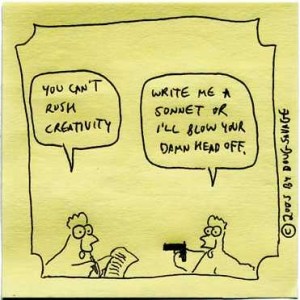
Thanks to Doug Savage for permission to use the Savage Chickens cartoon.
Writerly occupational hazard: New frontiers in creative foreplay
In the old days, writers sharpened pencils, checked the mail, experimented with melismatic renditions of "I'm a Lumberjack, and I'm Okay," polished the piano (the rich writers, I mean) and so on. Classic avoidance behavior, right? Anything's better than actually getting down to the hard business of writing.
Maybe not. Or at least maybe not entirely. I’m not the first to suggest that all the screwing around may well be a vital part of the creative process. Having exhausted the possibilities of melodically ornamenting classic songs, you return to your manuscript and, hallelujah, that recalcitrant plot problem is resolved. Like magic, perhaps one of your characters supplies just the snatch of dialogue needed to precipitate the missing dramatic profluence.
Creative foreplay. Simply getting away from the book for a relaxing stroll can be enough to tickle the Muse. Some part of "avoidance behavior," in fact might better be described instead as creative foreplay.
When avoidance behavior isn’t really. Sharpening pencils, listening to music, making a few phone calls, gazing at the nice day outside… You’re really working, eh? It’s like lateral thinking, or deliberately not thinking about a word that’s on the tip of your tongue.
But the art of productive screwing around has become much more difficult, in this modern age. You can sharpen all the pencils in the house, but, once they're sharp, that's an end to the matter. True, you can go on from there to polishing the furniture, but again, that gambit soon plays itself out. In any case, these are essentially restful, mindless activities, conducive to behind-the-scenes rumination and synthesis. In a way, you can do these things and still, on some preconscious level, be productively involved in your book. The difference today is we've got the Internet. Google, Amazon, personal blogs and websites, our friends' blogs and websites, Facebook, Twitter, games, magazines, books, news, commentary, Google Earth... We have the collective memory and, increasingly, the collective mind-in process lurking right behind that page of manuscript—the one that's proving such a bother and, boy, you sure could use a break, eh?
Dopamine addiction. So the first point is this: There's a ton of stuff to do rather than work, and much of it is pretty neat. Unlike with pencils and furniture, you're never going to come to the end of the distractions at hand. Many of them even come loaded with nice little hits of dopamine.
Secondly, for the most part these distractions aren't entirely mindless in the way sharpening pencils can be. They engage you. And they're infested with hyperlinks and whatnot that hijack you, pointing every which way, diffusing your attention and creative energies. Look at this! And this! Whoa, what about that? This effect then becomes multiplied exponentially by the fact you can flip effortlessly between Arts & Letters Daily, Facebook, e-mail, Twitter, a new lecture series, and even notes towards some other novel, one that's easier to write.
Or you can compose another blog item, like this one, the longer the better, because then you might avoid real writing till lunchtime, and then… Well, a man’s got to eat, eh?
Advanced avoidance behavior: Sharpen pencils somewhere new and exciting (and, if you’re really serious about this, beyond the reach of the Internet, should such a place remain).
Thanks to Doug Savage for permission to use the Savage Chickens cartoon.
Writerly occupational hazards: Addictions, spinal deficiencies, and disciplinary infinite regresses
One writer, however much tongue in cheek, has actually expressed admiration for addicts:
I admire addicts. In a world where everybody is waiting for some blind, random disaster, or some sudden disease, the addict has the comfort of knowing what will most likely wait for him down the road. He's taken some control over his ultimate fate, and his addiction keeps the cause of death from being a total surprise. ~ Chuck Palahniuk
Overall, though, even Palahniuk would probably concede that this advantage—a modicum of autonomy regarding the nature of your eventual passing (a half-assed sort of “suicide,” in plain terms)—is generally outweighed by a range of ill effects.
Traditionally, writers have too often succumbed to the temptations of drink, drugs and complicated women (or men). Among modern writers, however, the Internet threatens to become the biggest killer of creativity and real social lives. (Have a look, e.g., at Edward Tenner’s review in the Wilson Quarterly of recent books arguing two sides of the issue: The Shallows: What the Internet Is Doing to Our Brains, by Nicholas Carr, and Cognitive Surplus: Creativity and Generosity in a Connected Age, by Clay Shirky.)
Online existence becomes ever-more seductive at the same time concern grows at what harm it might be doing us. What isn’t at issue: In this brave new digital universe we inhabit, we tend to bathe our brains in a heady punch of dopamine (see, e.g., Psychology Today) and dangerous stress-induced chemicals (seen New York Times story). Parked there in front of your computer browsing the Web and answering e-mail, you can launch yourself on a fine gonzo adventure complete with “natural” uppers and downers and hangovers, not to mention disaffected better halves and everything.
My own Internet addiction has maybe left enough of a concentration span to compose haikus:
You have mail
Delivery vehicles,
Every e-mail
A dopamine fix.
Novels, on the other hand, require more attention. Unfortunately, my various projects mean I can't go cold turkey with the Internet, but I do need to find some way of disciplining myself. Something more effective than Sara's Rx.
"Just be more disciplined," she tells me.
Right.
I recently installed a program called Freedom, which is supposed to make discipline unnecessary. And it really works—you tell it how many hours you want to be independent of the Internet, and it forbids you access to all your communication programs for exactly that long. Plead and weep as much as you like; tell Freedom that Hollywood might be trying to e-mail you right now with an offer that expires in 20 minutes. There’s nothing you can do to change its mind. No recourse. Other than to go to your other computer, where you were careful not to install Freedom. Or simply refuse to activate Freedom. You may forget for months at a time, as I have, that you even have this program that set you back $15.
Now Sara tells me, “Just be more disciplined. Force yourself to activate Freedom every morning before you start your day.”
Right. But where do I find a program that activates Freedom automatically?
Um… (attention-span failure)
Kindle Singles. Score one for iPad enthusiasts. Soon there'll be no time to suffer the unfortunate effects of backlit screens. Kindles are better for extended reading? Yeah, well. Whatever.
Savage Chickens cartoon used with permission.