Japanieces & tilefish & things
What have tilefish and superyacht owners got in common?
Collin posed this question at the end of his last post, "Pharaonic fish and flash fatcats." And now he has invited me, Jack Shackaway, who remains unbound by considerations of political correctness, to explain.
The following passages are from a novel in progress starring yours truly — even written by yours truly though Collin will no doubt try to claim otherwise. The book is a work of fiction, but I'm real and the things described in this chapter, at least, actually happened. You could call it straight-up reportage. And here, something that Collin would never do, I insert a smiley-face: :) Hah!
chapter two
japanieces
“Japanieces!” Des told me.
We were standing in a large open-air hot pool high on a jungly hillside on the island of Langkawi, in Malaysia, palm fronds silouetted against a big moon overhead, bright strings of colored lights festooning the bar below. Only a few yards away, four luscious japanieces-to-be stood immersed to their bikini-tops.
“Oh, boy!” Des added.
Rich yacht owners have lots of nieces. You tend to find these items draped about their boats, many of them in advanced states of undress and sometimes, not often, more than half the age of their hosts. One theory has it that an inordinate fondness for nieces is the only reason someone who is otherwise of sound mind would ever buy such an expensive toy as a multi-million-dollar boat. In fact, according to Des, this amounts to no more than an expensive dick-enlargement operation.
“But we get to play for free,” he added. “God is good.” The mere sight of this congregation of Japanese office girls giggling and blushing away in the hot pool had instantly telegraphed a clear vision of the near future.
“You are staying in this hotel?” asked the cutest Japanese girl of all.
“No,” Des replied, looking as modest as any poor yachtie ever could. “We’re staying on a boat.”
Wild surmise swept the pool like an early monsoon gale. “You mean, the big white boat?” asked the second and third cutest ones. “The big white boat down in the bay?” asked the fourth, who was also cute, never mind there was only one yacht of any description anchored down there, and where else would you put a yacht anyway?
“Yeah. That’s right.”
Their eyes grew as huge as Japanese eyes could get, no doubt in the attempt to accommodate the immensity of this concept, this enormous amazing motor yacht way down below in the bay and the fact that we slept on it. The water in the hot pool began to boil all around us as the girls crowded closer. In no time we were on a first-name basis with Tomoko, Hiroko, Sachi and Yumiko.
“Want a drink?” I asked.
“Yes!” they chorused.
“And Bob’s your uncle,” said Des, with a broken-toothed grin, although I think he really meant to say that we were their uncles, for now, and these fine young japanieces should just relax and let us look after everything.
*
A couple of musicians were beating the shit out of a piano and drums while a bass guitarist measured the carnage. This gang of three plus a singer and trumpeter rushed from one piece to another, laying a vaguely bossa nova beat over everything from Bach to Bachman-Turner Overdrive, charging along as though they wanted to finish up and skedaddle before the cops arrived.
Des seemed just about as antsy. “Boy, those drinks look good, all those little parasols and slices of pineapple. Cherries and shit. Don’t let them get warm, now. That’s it. Down the hatch. There’s lots more of this stuff on the boat. Oh, my. Yes. On the yacht.” Once more, he pointed out the big plate-glass bar window to where Boomboom II sat far below on the water. “Cheers!” he said.
“Kampai,” the girls responded, which, as they had already told us, was Japanese for “cheers.”
“Japaneices, man.” Des whispered at me, waggling his eyebrows in a very discreet manner. “We got japaneices by the boatload. Oh, boy.”
Forget about how busted up he was, Des was a ladies’ man. Pretty soon he was talking to Tomoko in an anodyne semi-pidgin. “I never get rich from photography,” I heard him say, “but I am free.”
“Yes,” Tomoko said, squinting in the way women who are nearly blind and haven’t installed their contact lenses tend to squint. “I see.”
Even smart women like this Japanese office girl generally chose to overlook the essential banality of it all. Somehow, in some way unclear to me, Des’s whole manner and appearance signaled “good for the gene pool.” It probably related to his obvious capacity to survive anything existence could throw at him. Des had that look you see in veteran rodeo riders. National Hockey League goalies used to have it, back in the days before face masks. The look that said, “Do your damnedest; I’ve sustained lots worse and I’m still truckin’.” Nevertheless, Desmond’s most recent girlfriend had left. Bryanni said she still loved him, only she couldn’t stand watching him die the Death of a Thousand Boo-boos.
But he had big eyes and long eyelashes, which he batted, bimbo-wise, and no compunctions about telling a woman anything he thought she might want to hear, and right now he was making out like a bandit.
Meanwhile I was doing my thing, batting my own eyes and explaining to Sachi and Hiroko how I wrote travel articles and suchlike. Just to make a living. But I was really a novelist, when it came right down to it. An artist, really, though I didn’t use that exact word.
“Ah, so,” Sachi said. “What is your name again?”
“Jack. Jack Shackaway.”
“Ah, so,” Hiroko also said, maybe thinking I didn’t believe they were really Japanese.
They were asking where they could buy my books and I was waffling when Des came to the rescue.
“That’s right. And he’s a war correspondent too. Both of us are. Partners to the end. Brothers in arms.”
“Oh, yeah,” I said. “That’s right.” I’d been trying to forget our latest adventure.
Tomoko and Hiroko headed off for the bathroom, and Des, dropping the pidgin and maybe forgetting Yumiko probably didn’t understand one-tenth of what he was saying, took to telling her, “Yeah, you see, if I build up my photo stock just a bit more—flesh out Malaysia and so on—and with these agencies flogging my stuff in the States and Europe, I figure on retiring before I’m forty-five. Okay?”
Pretty little frown lines formed between her perfectly plucked brows. “Ah,” she told him. “So.”
“Wow,” added Tomoko. She and Hiroko had returned to the table and also pretended to know what Des was talking about, which was something Des himself did not.
“It takes discipline. A freelance photojournalist has to face temptation all the time. You know what I mean? But you can’t give in. You have to have goals, man, and stick to them.”
And Des was sticking pretty close to Yumiko, set to score this particular goal. And maybe still set to score another with Tomoko, since I knew he was capable of adopting any attitude it took to get laid, and maybe two at once. Attitudes, that is. New Age, Marxist-Leninism—whatever they wanted to hear. Even abject middle-class propriety, if that’s what it took, as seemed to be the case with Yumi.
“So.” She tried to jog his memory. “You sleep on the big white boat?”
That’s when we should have made our move—told the ladies to go pack their overnight bags and we’d hightail it for the boat. But Des had maybe had one too many drinks, trying to hurry the girls along, and now he decided the band needed help. In fact, the band really sucked, he told us right in the middle of their bossa nova rendition of “Hotel California.”
“The band really sucks,” he announced again, and he went up to this very band and asked whether he could sit in for the next number.
As a piano player, at least when he was in full stride, as he happened to be at this moment, Des was a cross between Fats Waller and someone trying to demolish a whole piano with his bare hands. As a matter of fact, Des did have his own personal martial arts style, which he’d learned at the same place he learned to play the piano, which was a succession of low-life bars around the world. It was called tae kwan whoa, he informed me once, just before he broke both a guardrail and his foot with one lightning kick. His piano-playing style, on the other hand, had no name, even though it could get a joint rocking under just the right circumstances which these weren’t.
I noticed the japanieces were already looking nervous about their new friends, when the crew from Boomboom II burst upon the scene like a nineteenth-century press gang raiding a Bristol tavern. ...
chapter three
godless
“There is no God.” Des proclaimed.
QED. There we were, japanieceless aboard Boomboom II and on our way to Burma...
…
So that's how Des and I got to appreciate on a gut level -- however briefly -- in what way tilefish and super-yacht owners are same-same.
Collin seems to be planning other tilefish-related posts. I can't say what those will be.
I hope you noticed the expression "japanieces," which is a neologism coined by none other than me no matter what Collin might tell you about its provenance.
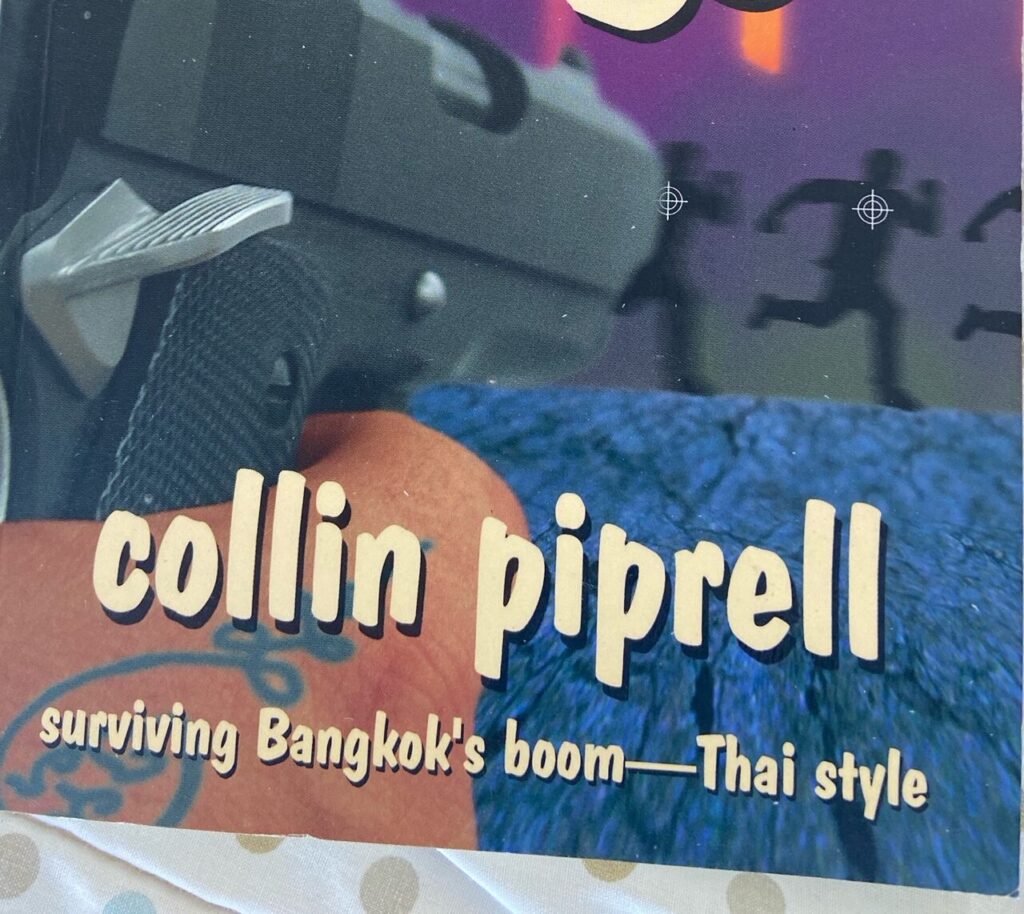
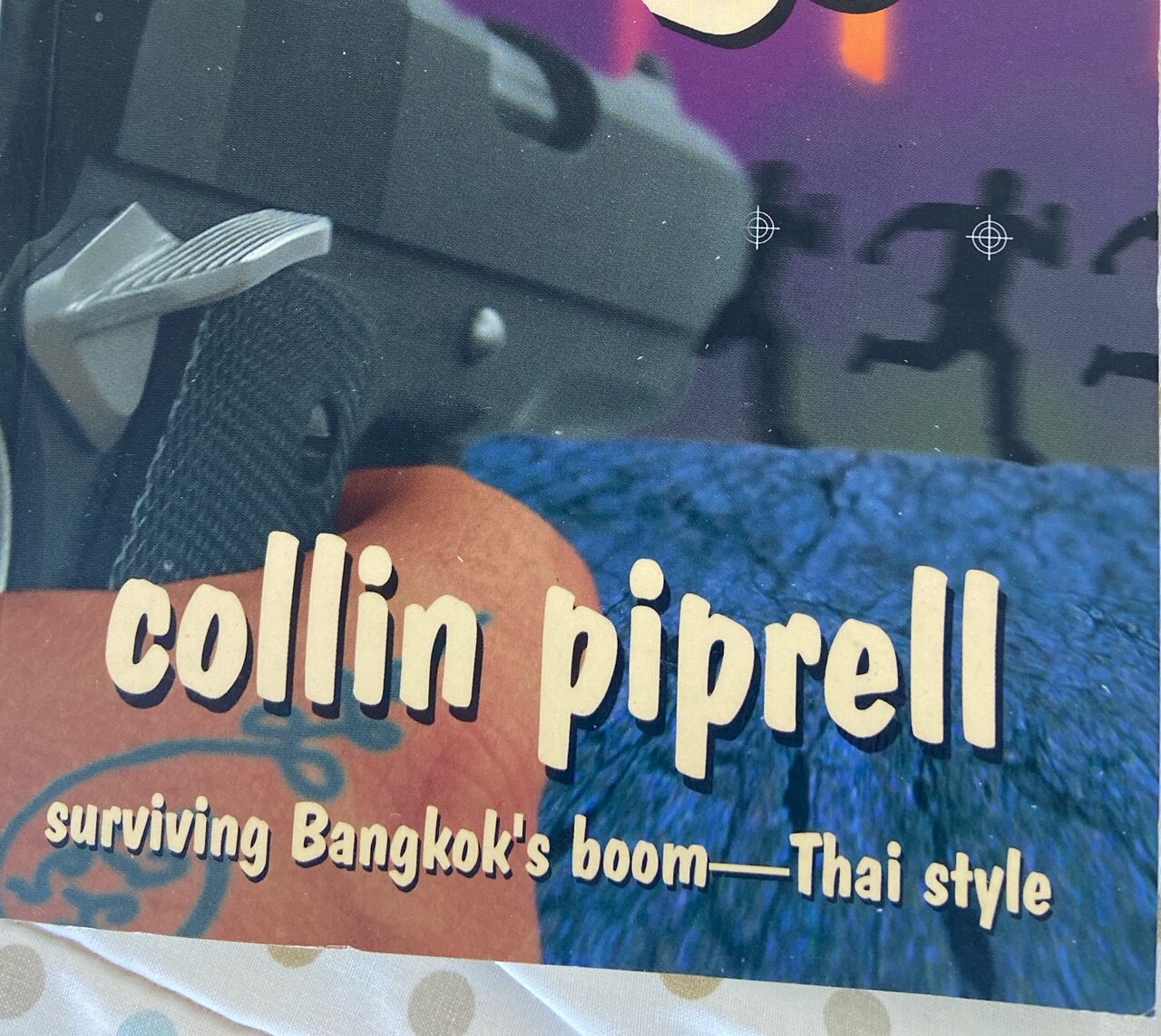
Have a look at Kicking Dogs, an earlier novel starring me, written by me, hijacked by Collin, out of print and currently languishing on the Internet as an utterly neglected e-book. Collin is even worse at promoting books than he is at writing them.
...
Photo of Amanputri by J. Everingham.
J.B.S. Haldane, perhaps more of a wag than most of his ilk, famously suggested that "The Creator, if He exists, has an inordinate fondness for beetles."
Peas in a pod: Pharaonic fish and flash fatcats
According to the people who filmed these tilefish back in 2003, this species had till then remained undescribed by scientists. Once again I’ve been too slow off the mark, because I described this fish in 2001. I can't find the original video with the associated claim, but here's some excellent footage of tilefish and their mounds.
I’ve been known to brag about having already been there and done that, years ahead of my time way back when (e.g. see “Chronicle of an urban drowning foretold”). Today it’s time for a new brag: Here’s something I noted in a dive log from a Mergui Archipelago trip back in May 2001. The main point is the tilefish pyramid sighting (I add the rest only as background and to show how rich the marine life was).
Unnamed reef just north of G.W. Torres
dive (24 May) Breaking waves at surface. Down to 60 feet. Interesting topography, rocky ravines with staghorn thickets in bottoms, big fans on walls. A wall, boulders, down to sand. A couple of 2.5m sharks, prob. gray reef sharks. Several blue-spotted rays, a very big lobster. A few big groupers. Saw four different sea urchin species within a small area (black long-spined, little blue-and tan jewel boxes, whiteish porcupine quills, and a pencil urchin). As I waited for pickup, spotted a pink jellyfish with 2-3m tentacles and little fish seeking protection among them.
Same reef, but on the outside (western side)
dive (24 May) The deep V cove where we anchored for lunch has a vast area of coral heads set in vivid turquoise water. Fine first-growth forest on both sides, tall whiteish trunks, high canopy. It’s been sunny all afternoon, with cirrus and haze on horizons. The point of the cove, on the left as you go out — same side as the unnamed reef — is a jumble of Similans-style granite boulders. The whole shore along that side, out of the cove, is boulders. Also between shore and reef. About 26m of water. At low tide, the reef breaks at about 1.5m. Lots of boulder diving. In 14-20m shallows coming up, a good surge, caves and swim-throughs for “bouldering”. A big electric blue crown-of-thorns, another big grouper (0.75-1m long), sea snake, Hawksbill turtle (Bonnie touched it after Graham spooked it and it swam right into her), a tuna, lots of reef fish (lots) in shallow sunlit waters.
Tilefish (blue, 10”), in pairs — mound-builders at 25m. One fish book gives a related species a range of 30-115m. Different books mention different species, one bigger, one smaller. The biggest mound (coral bits/rubble) was about 12’x8’x3’ high. That one was also topped with a smooth, regular crater like a little volcano. On some of the mounds you could see the entry/exit hole. One of a pair swam into one while I watched; the other stayed outside.Good corals.
Dougal, who got separated from the rest of us, claimed a shovel-nosed ray. We left the reef unnamed.
And some field notes from surface
On the boat later, I observe a well-endowed fellow diver display herself in a silvery bikini. Meanwhile a diver dude appears set to out-display this vision. He’s wearing a psychedelic wetsuit fit to give me a headache and top-of-the-line gear including outsized fins that could mark him as an aspiring Olympic underwater speed swimmer or something.
So I’m thinking this, and I’m thinking that, and suddenly I realize what the tilefish pyramids are all about. It’s a sexual display. It's “I’m the man” behavior common to all kinds of animal species, including Homo sapiens. These tilefish mounds become exaggerated out of all reason as a courtship display. Any specimen with that much energy to squander on building pyramids would be guaranteed the pick of the prom. It's a pharaonic fish's equivalent to the peacock’s tail or swimfins too big for this trimaran. An enormous expenditure of resources simply to say "I can afford to do this. So mate with me."
The male of our own species has come up with so many ways of advertising his masculinity it puts the tilefish to shame. Tune in for the next post in this series to learn more about what tilefish and superyacht owners, e.g., have in common.
Here's an interesting note from an invertebrate neuroethologist who presents evidence that peahens may not really be looking for tail, as such, after all.
Saving the world: Sea squirts to the rescue
Save the whales; save the gibbons. Yeah, yeah. But here's how to help save the whole world. Be the first on your block to start ranching sea squirts. It seems these leathery wee bags with two openings and way-kinky social lives might be just what the doctor ordered when it comes to clean energy.
Back in 1995, at the request of White Lotus Press, I collaborated with photographer Ashley J. Boyd on a natural history of Thailand’s coral reefs, including their distribution and condition.
Here’s something from the mini-field guide to local marine animals we included at the back of the book:
ASCIDIANS (Phylum Chordata, subphylum Urochordatga)
These animals are more commonly known either as sea squirts or tunicates. ‘Ascidian’ is derived from askos, the Greek for ‘wine flask,’ and very often they do resemble leathery little bags with two openings — one to let in water bearing oxygen and plankton, and one to let waste water out. They can close one or both openings, but more often leave both open, with a stream of water passing continuously through. A 30-mm sea squirt can filter about one liter per hour (they range from several millimeters to several centimeters in size).
However primitive this description may make the sea squirts seem, they do in fact have stomachs, intestines and, being hermaphroditic, not only a testicle but an ovary too. The test surrounding these animals is supplied with blood vessels. The mantle has muscles by means of which the tunicate can open and close its siphons or contract the body as a whole.
Ascidians belong to the Phylum Chordata. Although they do not have a backbone, their larvae have notochords which help support muscular tails and which are evolutionary harbingers of the true backbones. The larvae also have gill slits, which would also seem to ally them more closely than their adult forms to the higher organisms. It is indeed thought possible that the tunicates are the ancestral chordate — ancestor, that is, to all of us.
In their adult phase the tunicates become sedentary (much like many humans), attaching themselves either singly or in colonies to the undersurface of rocks on the reef flat, to the roofs and walls of caves on the reef slope, and to the sides of holes and crevices. They also make some contribution to the consolidation of rubble caught in depressions around the reef rim (although ascidians can be found everywhere from the low tide mark to the ocean deeps as well).
Their social life is more interesting than one might grant at first glance. Besides propagating hermaphroditically, for example, some reproduce by budding. And individuals sometimes cluster around a single common cloaca, thus constituting ‘composite ascidians.’ So-called ‘social ascidians,’ on the other hand, remain united to the parent individual after budding.
Sea squirts are protected from humans by the fact they aren’t much good for anything (or so it was believed until it was discovered that some yield substances, such as didemnin B, which are helpful in the treatment of leukemia and tumorous growths). Their tough, leathery bags protect them from a variety of other predators, however, notably starfish and various species of mollusk. The sessile varieties, though, are often displaced by more competitive organisms such as sponges. In at least one instance, tunicates offer protective camouflage to another animal — some types of crab characteristically carry an envelope of sea squirts which may help protect the crustacean from its enemies.
There is a class of tunicates (Thaliacea) which are free-swimming. Ranging in length from a few centimeters to two meters in length, these animals are transparent, cylindrical or cone-shaped creatures sometimes mistaken for jellyfish.
Note the remark regarding their possible use to humankind:
Sea squirts are protected from humans by the fact they aren’t much good for anything (or so it was believed until it was discovered that some yield substances, such as didemnin B, which are helpful in the treatment of leukemia and tumorous growths).
As it turns out, however, these interesting critters, which quite possibly incorporate the evolutionary prototype for our backbones, could well have a greater role than that to play in the scheme of things. Here’s something an environmentalist friend and sometime diving companion from Bali just sent me:
Five researchers at the University of Bergen (UiB) and Uni Research say they found the marine animal tunicate could be used as a renewable source of biofuel. These marine animals serve as bacteria eaters and as a foodstuff in Korea and Japan right now, but the cellulose, the protein and the Omega-3 fatty acids in tunicate are the cause for its many uses.
“Its mantle consists of cellulose, which is a collection of sugars. When cellulose is cleaved, one can obtain ethanol. And ethanol can be used for biofuel in cars. The animal’s body consists of large amounts of protein and Omega-3. This can be used for fish feed,” says Professor Eric Thompson at UiB’s Department of Biology.
The researchers say they have already acquired a patent for biofuel and have a patent application pending for the cultivation of tunicate as fish feed.
Dr. Sc. Christofer Troedsson of Uni Research’s Molecular Ecology Group and head of the research at UiB’s Marine Development Biology and the tunicate research project said the bioethanol used today is unsustainable, as it comes from foods already used for human consumption.
“That is why there has been a move towards using cellulose from the timber industry to produce bioethanol,” Troedsson said. “However, it is quite complicated to break down the cellulose in trees and convert it into ethanol. This is because the wood contains a substance called lignin, which is hard to separate from the cellulose. Tunicates contain no lignin. Their cellulose is also low in crystals and is more efficiently converted into ethanol.”
He said using tunicate rather than trees is more environmentally friendly because it does not occupy large tracts of land that could be used for other purposes.
Tunicate, specifically the subspecies ascidiaces, is not in the food chain, so there are no creatures dependent on it to survive. They also grow quickly and are found in all oceans.
“We have spent years to arrive at these findings, so the prize is a nice recognition. Now we look forward to working on commercializing the results,” says Thompson.
Another ocean dweller scientists are looking at for a source of biofuel is algae. Last November, engineers from the University of Michigan said they “pressure cooked” algae for as little as a minute and transformed 65 percent of the green slime into biocrude, a process that typically takes Mother Nature millions of years. Researchers believe an area of algae the size of New Mexico could provide enough oil to match current US petroleum consumption.
So what can we learn from all that? First, it's clear we need to show more respect for our fellow creatures, no matter how obscure and apparently insignificant. Global extinction rates are currently running at tens of thousands of species per year, and many of these creatures are disappearing forever because of careless human activity. Even if we put aside their intrinsic value and interest as unique expressions of our world’s creative emergence, we just never know when a species is going to prove useful, even commercially valuable.
So guess where I’m putting all my money. Sea squirts rool, OK!
“Aha,” says my Sara, in what might be an admiring tone. She knows I didn’t get where I am today by being blind to trends.
Thailand's Coral Reefs (Bangkok: White Lotus, 1995), by Collin Piprell. Photos by Ashley J. Boyd. Natural history and conservation of reefs. Out of print.
Tunicate photo by Ashley J. Boyd.
Starbucks is a jungle
I’m sitting here like a prat in a coffee shop renowned throughout the modern world as the natural habitat of prats with laptops who, in their whole attitude and disposition, claim to be writers. I’m struggling to make sense of a world of my own design and construction. In fact, I grapple with an idea so arcane that previous science-fiction writers who entertained it had to be institutionalized.
I look up from my MacPro to gaze at the ceiling reflectively. On the way, I pause to smile, fondly enough, at a klatch of females with their young.
Then one of these young items screams. Piercingly and at length it shrieks, triggering a couple of its wee associates thereby.
What it sounds like: toddler shrieks.
This atavistic behavior, according to one theory, was originally meant to alert adults to the news that a leopard lurked nearby and steps needed to be taken. Maybe so. But I’m pretty sure there isn’t a leopard within a radius of many kilometers and, if there is, it should only eat this shrill young specimen who could alternatively be kept shielded from civil society in a lead-lined bunker.
Of course such behavior has lurked deep in primate genomes since our days as monkeys, and this may explain why we find scratching on blackboards so unpleasant (though this hypothesis has been questioned). I suppose it might be forgiven on that account by genuine adults, which is something I don’t claim to be.
Mind you I had a late night, and this ms. isn’t going all that well even without 130-decibel assaults on my unsympathetic nervous system.
I’m something of a curmudgeon at the best of times, which these are not, and I turn a look on my fellow patrons designed to reduce them to quivering protoplasm. They mistake this for something benign, and smile at me in ways that suggest I’m adorable, though not as adorable as their screeching spawn, the shrillest pair of whom now toddle towards me trailing drool.
“Do you think they build these coffee shops only for you to write books in?” Sara asks me later. Then she adds, with little conviction: “Really, you thought those kids were cute, didn’t you?”
Useful notes:
* “The human threshold of pain is 120 [decibels], and at 160 your eardrum will rupture.” (Australian Geographic)
* Human babies, if they’re in good form, reportedly can do 130 dbls. That’s like listening to a jet plane rev its engines at 40 meters or so.
* “Former Wimbledon champion Maria Sharapova … has officially reached 101 decibels (a lion's roar is 110 decibels).” Wikipedia. So what? It gives me an excuse to post her photo.
* What high-pitched noises can do to the average urbanite’s brain.
* In Bangkok, both parking-lot attendants and traffic police labor under the misapprehension that cars move only if you keep blowing shrieky whistles at them. Quixotic Resistance Movement Award of the Decade goes to Quiet Bangkok.)
* Visit this site for a less interesting hypothesis than the one advanced above for why toddlers shriek this way, plus a viscerally less satisfying way of encouraging them not to.
What’s lurking beneath *your* garden?
Rude revision to one’s life plans: Florida man disappears with bedroom into sinkhole.
The news these days is enough to have us all hiding under our beds. Not that this strategem is foolproof, it seems.
Other network-newsworthy causes for alarm:
Near miss: asteroid.
Near miss: meteorite shower over Russia (largely spares pop. centers).
Near miss: fiscal cliff; sequester still plunging through atmosphere inspiring panic in many quarters.
Etc.
How many other near misses go unnoticed and unremarked? There’s a whole range of trolls, some of them as yet unimagined, lurking beneath our individual and collective gardens.
Here’s a clip from a 2009 Wall St. Journal interview with Cormac McCarthy (author of The Road, a fine post-apocalyptic novel).
WSJ: When you discussed making "The Road" into a movie ... did [they] press you on what had caused the disaster in the story?
CM: A lot of people ask me. I don't have an opinion. At the Santa Fe Institute I'm with scientists of all disciplines, and some of them in geology said it looked like a meteor to them. But it could be anything — volcanic activity or it could be nuclear war. It is not really important. The whole thing now is, what do you do? The last time the caldera in Yellowstone blew, the entire North American continent was under about a foot of ash. People who've gone diving in Yellowstone Lake say that there is a bulge in the floor that is now about 100 feet high and the whole thing is just sort of pulsing. From different people you get different answers, but it could go in another three to four thousand years or it could go on Thursday. No one knows.
Re-reading that McCarthy interview, and hearing about the unfortunate Florida resident, I was reminded of a story I wrote in 2004 about the Andaman Sea tsunami, which killed nearly 230,000 people and caused incalculable property damage (“Monster Beneath the Garden,” by Collin Piprell, Phuket Magazine). The lead to that story is especially pertinent.
It’s like having some fabled subterranean monster beneath your garden. One minute it’s all butterflies and flowers and skipping about in the sun. The next, the earth opens up to devour you.
Countries bordering the Andaman Sea and Indian Ocean have long presented the world with a vast tropical playground of beautiful beaches, rich forests and marine life, exotic cultures and welcoming local people. And the Phuket area enjoys an added attraction — historically, it has appeared all but immune to natural disaster. Even typhoons have been rare and generally weakened by the time they hit this part of Asia. “Disasters” tend to run to such things as a temporary drop in whale-shark sightings among scuba divers.
For untold years, meanwhile, a monster lurked beneath this idyllic garden. Perhaps 40 kilometres beneath the sea bottom not far west of northern Sumatra and running north under the Andaman-Nicobar islands and beyond, colossal pieces of the earth’s crust, subjected to unimaginable pressures countered by friction between these blocks, were trying to slide past one another along a 1,200-kilometre fault line. Given the current state of geophysical sciences, there was no way to anticipate when the slip would come. But come it did. In the event, it set off an earthquake measuring 9.0 on the Richter scale, the world’s biggest in 40 years, and violent enough, according to geologist Kerry Sieh of the California Institute of Technology, as quoted by CNN, to make the Earth wobble on its axis.
The point of all this? What with devastating tsunamis and sinkholes under beds, I find myself periodically reflecting on the contingent nature of our moment-to-moment existence. From this perspective, current threats from disciples of Ayn Rand and Al Qaeda together with renewed economic recession to my financial prospects may pale beside other quirks of Fate.
Never mind. My office ceiling might choose this moment to collapse on me, spelling an end to concern about any of this, including calderas pregnant with surprise or some micro-meteorite on a trajectory to aerate my head.
“What a good idea,” says Sara. I'm not sure what she means by this. It's hard to interpret her smile.
_______
Sinkhole photo from the Christian Science Monitor.
For more on the Yellowstone caldera: "Yellowstone's Plumbing Exposed."
Tsunami map from http://tsunami2004videoarchive.com.
Zombie nation: Shutting down
In my previous post I suggested that persons and cultures, our very realities, are narrative in structure. What happens when you interrupt such narratives?
Many of us are finding out, thanks to our increasingly ubiquitous and much-beloved digital communication technologies. There follow two especially obvious ways this is happening.
Applying a cell phone to the side of one's head in public has the effect of disconnecting the brain. In this condition, cellphone users show characteristic signs of aimlessness, milling about on sidewalks and bumping into things. At the same time they lose all sense of courtesy, entering a solipsistic world wherein lanes of sidewalk traffic and right of way on escalators cease to exist. They step outside the collective narrative that is our conventional civil society.
Yammer away all you like, forget about the person standing next to you on the Skytrain. Sure. And pose in generally awkward locations as — compliments of the advertising industry and celebrity stooges — you slip into one prefab persona or another, aping the beautiful brainless people, exulting over how cool you are as, phone clapped upside your head, you stand framed in doorways and at the tops of escalators. The idea that you are both cool and connected is the only storyline establishing the continuity of these moments. This is who you are.
Musing along these lines, I suddenly realized something. A parallel kind of thing afflicts me when I succumb to the Internet urge. It’s as though the narrative that is me, as I want to think of myself, is abruptly paused. Confronted with iMail, Facebook, Skype, Google, etc., my attention explodes across the many distractions at hand. And, in some way I can’t articulate very well, my sense of self becomes diffused in the same way.
spring day darkening:
the locust digital swarm
eats my absent mind
In part, I metamorphose into something like a lab rat with an electrode planted in its pleasure center, hitting the jolt-me button again and again in preference even to the buttons for food or sex, even unto dying of friggin’ starvation. But that’s just a white rat, eh? Whereas I am a card-carrying member of the elite species Homo sapiens. So I don’t need no stinkin’ electrode stuck in my hypothalamus. No, I simply go online, where I can get many, many discrete little hits of dopamine, dipping away like a demented dipstick till all my creative projects lie dead in heaps on my study floor. We call this a higher-order activity. It’s Progress.
But it’s such a relief not to have to concentrate on anything. What a gas, the relative ease of bumping around, Brownian particle-fashion, among the myriad other bits of persons and their digital spoor, just going with it, eh? Wherever, and whatever. Like I’m being absorbed by the collectivity, and there’s no real “me” left to worry about things. Until I re-emerge from cyberspace which, at least so far, we all have to do eventually.
“Just turn off the Internet router,” my Sara tells me. Right.
_______
The "Walking Zombies" image is used with permission from ChargeAll.
Realities and stories: Realities *are* stories
The big news du jour — after the colorful and convoluted transgressions of celebrity athletes — is the imminent Academy Awards. The three top contenders for Best Picture are Argo, Lincoln, and Zero Dark Thirty. These three have at least one thing in common: They all stand accused of playing fast and loose with the historical truth of matters.
But what is “objective” about history or, for that matter, about reporting? History is always written by the victors, etc. What we “know,” or believe, about our respective pasts (and presents) always involves reconstructions on the basis of only partial information, observed from particular POVs, always interpreted by people with linguistic, cultural, political and idiosyncratic personal biases. I’ll suggest that 10 different movies about the killing of Bin Laden by 10 different studios would paint 10 different realities, no matter how respectful of the truth they thought they were being. Each would only be “true” to some degree, and from some perspectives. What does Al Qaeda make of Zero Dark Thirty?
Ben Affleck, Argo’s director, has justified in terms of the pursuit of art his taking liberties with certain facts of the Iranian hostage-taking of the US Embassy staff. “It's that struggle between ... the bookkeeper's reality,” he suggests, “and ... the poet's reality.” He believes that this movie has done justice to the essential events and issues, while winning them a wide audience through an artful and entertaining presentation. (NPR interview, “Affleck On 'Argo' and the 1979 Hostage Crisis”)
I’ve just seen the film, which I think was excellent, and I don’t care if Affleck tidied up some details in the interests of managing a dramatic storyline (e.g. having all of the escaped embassy staff holed up in the Canadian Ambassador’s residence, rather than both there and in his deputy’s house). It was a ripping good yarn, and it was inspiring to know it was based on “real events.” And I have no problem keeping my entertainment and my sources of more factual accounts separate.
Breaking news: Bill the Mathematician has informed me that Affleck & Co. seriously short-changed the Canadian input to the hostage rescue, awarding nearly all the brownie points to the CIA. So I’ve just changed my mind about everything I said earlier, eh?
Whatever. Many people like to expound on the difference between “real life” and fiction, fiction being merely made-up stories or, worse, a pack of lies. Real life, on the other hand, is real. By God, eh? Implicit in this proposition: They know what reality is and what it is not.
Well, here’s some news from someone (me) who really knows what is really real and what is really not. Our individual personalities are narratives, under continuous personal and collective construction and maintenance, as are our cultures and even our entire universes. Modern science is able to tell compelling stories supported by rigorous method and criteria of “objectivity” that make it unusually possible to agree across cultures and ideologies and so on about what is real and what isn’t. But these accounts remain narratives, and as such are subject to revision and even radical reinterpretation in the context of new information.
Are we living in a sim?
Militant custodians of the real realities (except for me) tend to hide a real horror of having their beliefs questioned, an unacknowledged fear that doubt or even too much imaginative play will bring the whole house of cards down around their ears.
The thing is, we live stories of our own personal and collective telling. In fact the difference between a good novel and what, in any given context, we term “reality” is in no way clear cut. Fiction and conventional realities are both narratives. Furthermore they inform and shape one another.
Enough for now. More later on narratives, selves, cultures, realities and the truth about why I got home so late last night.
So, Sara: Are you ready to listen now?
Safe and cosy
Posted from under my bed: Totalitarianism rools, OK! Don't see any way around it, given the politics of fear combined with the ever-more extensive collection and storage of data subject to interpretation by ever-more sophisticated programs.
Alternatively, doesn't it give you a cosy feeling to know that the Powers That Be are doing such a good job of protecting us from all that bad stuff out there? Especially when we know these Powers are so enlightened and so consistently benign. So I'll just post this link and my comments here and on Facebook too, why not? Let’s give Big Data an early chance to record and ruminate over these sentiments. Wait a minute... What's that outside my window? ...
Simple paranoia? Maybe not. Check out this video from The Atlantic's website.
What is writing?
J.P. Donleavy, an early literary hero of mine, was quoted in Playboy (May, 1979) as saying, “Writing is turning one’s worst moments into money.”
Would that this were so. Meanwhile, another spin on the essence of writing is going the rounds on Facebook:
In other quarters, writers instead turn whiskey into piss and engage in binge writing in the intervals between their alchemical endeavors. (I encountered the expression “binge writing” listening to a Letterman interview with Hunter S. Thompson.)
But let’s leave the last word to Norman Mailer:
“Writing books is the closest men ever come to childbearing.” (NY Times Book Review, 17 September 1963)
Typically, perhaps, he leaves the female writer’s experience out of this account. So maybe we can instead allow me the last word:
Writing books is the closest women ever come to knowing what it’s like for men to come as close as they ever can to giving birth.
And there you have it, another fine aphorism hot off the press.
Illustration from Platt R. Spencer, Spencerian Key to Practical Penmanship, 1869.
Portrait of Hunter S. Thompson from "Gonzo: The Life and Work of Hunter S. Thompson," by Peter Bradshaw (Guardian, 19 Dec. 2008).
Whiskey is of course a false Muse.
Tans for two: Multitasking tea-time
So I’m sitting here on my balcony with this commanding view of rich folks’ gardens, assailed by birdsong from left and right, and I’m bonding with my Bali pig.
In fact I’m multitasking. I’m reading in the sun, improving my mind though not so much I know better than to work on a tan at the same time.
I’m drinking tea—my souvenir sencha from Japan—a rumored antidote to damaged chromosomes. I remain skeptical in this regard, but trust the placebo effect to offset the UV radiation.
Meanwhile I’m also helping the pig get some color. I’ve adopted the habit of flinging the dregs of my tea at it, staining it nicely tannin even as I brown in the sun.
I bought the pig in Bali from master craftsmen, part of their craft being that of antiquing artifacts of their own recent manufacture. So I carry this hoary objet back on the plane, it’s so big I nearly have to buy it a ticket. And the maid sees this new member of our household and thinks, this is one classically dirty pig, no one has cleaned it in maybe 200 years. The next thing I know, she takes a wire brush and scrubs it right down to raw-red earthenware, so it looks as though it was born only last week, which indeed it was, goddamn it.
Now, between the elements—which include wind and rain and lichens that appreciate a nice splatter of pigeon shit from time to time—and my persistent flinging of tea dregs, the pig could pass for 20 years old in a dim light.
All the while the sunlight and tea are supposed to be taking years off my apparent age.
“Not working,” Sara tells me.
Though she does believe this habit of reading in the sun, forget about what Thai tradition and modern medical science have to say about it, does mean I’m still a child inside.
Regular visitors to this site, of whom there are none, might recognize the pig from the recent “Two hats” post.