COLLIN PIPRELL Generating realities, exploring them, losing the thread.

17Mar/113

Rules? I don’t need no stinkin’ rules

Posted by Collin Piprell

Well, maybe just a few.

A writer should find a good chair, e.g. Install it right there in front of  computer, pencil & pad, whatever, and then sit in it for extended periods, writing stuff.

Here’s a real lode of good advice from The Guardian10 rules for writing fiction from each of a bunch of prominent writers.

And here are five tips of my own, something I recently added to advice emerging from a Clarion Science Fiction and Fantasy Writers’ Workshop (which I didn’t actually participate in, aside from posting my two cents worth on their blogsite):

1. Ignorance can be a real virtue. Don’t collect too much in the way of information and ideas before you begin writing. With academic theses, feature stories and science fiction alike, it’s often best to spin as much of the story as you can before you do most of your research. Ignorance simplifies things enormously, since you have fewer elements to synthesize from the outset. Wait till you’ve got the story up and staggering about before worrying too much about incorporating all the ideas in the world. It’s easier to be selective, at that point, and much easier to organize all the ideas now that you have a basic framework. The storyline can always be revised in light of new information.

I still have problems following my own advice, mind you. It can be far easier to “research” than it is to spin fiction. Just as it’s easy to convince yourself you’re really working on the novel when in fact you aren’t.

2. Hit the ground running. Write first thing in the morning, when the stuff your subconscious has been working on all night is still fresh. (I have a hard time not thinking of this product as “night soil,” which in Chinese refers to something rather different.) A character in a Graham Greene novel describes this as a process of remembering and recording, more than of creating something out of whole cloth.

3. In light of (2), try to fix your life such that each morning the first thing that arises in your mind is the writing project. Making a living at things other than fiction interferes mightily with this, of course, where instead you awaken niggled to creative death by all the chores and commitments of a freelance feature writer or editor (or instructor or gun runner or whatever). This refers us to Tip #3 in Clarion's lead list: “Pick a life partner with money.”

4. Every journey of 1,000 miles… The mere thought of all that remains to be done on a novel may induce paralysis and despair. You have to remind yourself how fast the days and weeks and months go by, and how fast a regular daily increment of writing amounts to a book. A whole life can slip away just as fast while you tell  yourself that today (and the next day, and the next) would, for example, be better devoted to background reading; you can always get down to the actual writing mañana. An equivalent warning from the Buddhist Dhammapada:

Think not lightly of evil, saying, "It will not come to me." Drop by drop is the water pot filled. Likewise, the fool, gathering it little by little, fills himself with evil. Think not lightly of good, saying, "It will not come to me." Drop by drop is the water pot filled. Likewise, the wise man, gathering it little by little, fills himself with good.

5. Conciseness is a cardinal virtue. This advice is old hat, I suppose, but I’m always amazed at how—even after I know I’ve already honed something down to the bones—it seems I can always find more fat on my prose.

Exercise in conciseness: Revise a ms. as best you can, paying, as you always should, special attention to conciseness. Then do the book design yourself. (Anyone preparing a book for Amazon’s Createspace or Apple’s iStore will need to do this.) In MS Word, e.g., activate Justify and Auto-hyphenation. Fix hyphens, widows, orphans. Then reset the line leading, and repeat the previous step.

You’ll find that much of the hypenation is inappropriate. If you’re anything like me, you’ll then do your darnedest to eliminate all the hyphens manually, mostly by finding words you can trim away. And these words will be there, despite the fact you would have bet big money no fat whatsoever remained on that draft.

Repeat all the above steps, and be amazed all over again at how perfect conciseness has once more eluded you.

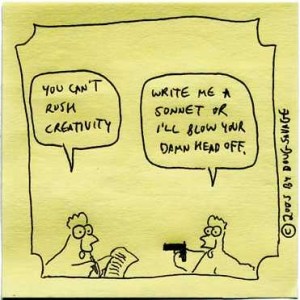
Thanks to Doug Savage for permission to use the Savage Chickens cartoon.

14Feb/113

Qubital worlds save Pyramids from erosion by camel crap

Posted by leary

Leary here. Wherever that might be (not to mention when).

Current affairs written on the wind (“mere ephemera,” according to my editor, which I didn’t ask). Right now, many of you folk back in 2011 will be fretting about political events in Egypt. The papers should be full of it. (You could still read newspapers back then, and they were often full of it.) No doubt the TV networks will be talking it up like they discovered Egypt only last week, and isn’t it amazing?

But that was just politics and economics and unhappy people, all of it written on the wind. Meanwhile, much more important issues were being neglected—the kind of thing that tends to evolve over many years and resists packaging as soundbites. (In fact, network news went on to nibble our world half to death, hardly noticing some other things that were about to chew up the whole shebang and swallow it, hardly leaving a crumb.)

More substantial issues. I won’t even mention China or emergent collectives or the PlagueBot. What would be the point? But here’s an Egyptian problem, one related to what was an world issue so important it made politics du jour pale by comparison. Though nearly nobody noticed (“Do you want that alliteration?” asks my editor, as though I need a machine holding my hand in this matter) because it wasn’t entertaining or dramatic enough. The Great Pyramids stood for more than 5,000 years. They may have even survived the PlagueBot, who can say?  (That would be worth checking out.) Early in the 21st century, though, about 50 years ago, some people noticed the Pyramids were being eroded by piles of manure from where thousands of tourists rode camels around them, not to mention crusts of salt from where thousands more visitors sweated all over everything. (Never mind the city of Cairo had already spread out to swallow the Pyramids anyway, with highrises, traffic and air pollution also doing their bit.)

That was just one example of where mass tourism—along with urbanization, industrialization and human carelessness, not to mention plain old cussedness—having already made a mess of our natural environment, went on to destroy our cultural monuments. Rising sea levels soon made much of this problem moot, in any case. (Yeah, yeah. I know. Bad style. “Moot” interrupts the flow of my argument, since many readers will stop to savor this too-rarely used word. So says my editor, which knows many things I don’t, including whether I should worry about having many readers, never mind whether they’re going to be stopping or not.)

Qubital saviors. Then along came the generated realities. Now we had a way everyone could enjoy all the forests and pyramids anybody could handle, they didn’t even have to sweat on them if they didn’t want to. Didn’t even have to leave the comfort of their own homes. And the real items, what was left of them, would be left to recover. Except that before you knew it there wasn’t anything left of them to recover.

First we got the Troubles, then sea levels surging higher, and then the PlagueBot, which spelled an end to most of the Troubles and just about everything else as well. But what the heck.

THE PLAGUEBOT: READ ALL ABOUT IT

If you want to know something about what followed the PlagueBot—though I don’t know why anybody would, darn it, not unless they thought it was possible for me to change the past by telling you about our future which, I’m sad to say, it isn’t—you can read Syn (awaiting publication). Find out in advance how the human race looked set to become extinct, with the machines taking over and everything. If all that’s true, of course, then how could I still be blathering away, here in the future, expecting anybody to read these chronicles? Well it’s been a near thing, I have to say, and the whole story has yet to be told.

One thing, nobody’s worried any more about who’s running the show in Egypt. There is no Egypt. In fact, countries in general are kind of passé.

So you should read Syn and the novels to follow in the series, not yet published. (In all modesty, I have to admit that these novels draw on privileged information.) According to Collin the first two in the series, with any luck, will be ready soon, though he doesn’t want me divulging the titles of the second novel or the series at this time.

13Nov/104

Submarine garrets for starving writers

Posted by Collin Piprell

Writers look for budget accommodation  (Bangkok, 2027)

Here are some things that didn’t fit on the graph in my “Things fall apart redux” post.

The price of fish in Villa Supermarket is soaring, the Gulf of Thailand is getting fished out, China is behaving more aggressively as the superpower-in-waiting, I’ve lost my mother’s copy of Ben’s secret recipe for Montreal smoked meat and I now learn Ben’s deli closed two years ago. It's as likely I'll get to taste roasted dodo as it is I'll ever again savor the finest smoked-meat sandwiches in the universe.

Of more immediate concern to me: the dollar is plunging and the baht is soaring. Next thing, I’ll have to forego those wee dollops of caviar on my deviled quail’s eggs. Could it be that these and other standard sufferings of  the artist will finally to turn me into a writer of substance, no doubt shortly after my demise?

That’s right. And sea levels are rising right along with the baht, promising to leave Bangkok a giant divesite in seven years, at least according to one pundit.  (The TAT, the Tourism Authority of Thailand, should be pleased, and we'll finally have the definitive answer to our traffic problems.) I don’t mean to seem immodest, but Ham Fiske (one of my many alter egos) published an article in the Bangkok Post more than 20 years ago predicting just this outcome. I was ahead of my time, unappreciated as a pundit par excellence, by God. See “One Born Every Minute,” from Bangkok Old Hand (Post Books, out of print).

But now the Bangkok Governor and his people are talking about spending quite a few billions of baht to see what can be done about this potential inconvenience, this business of becoming a submarine city. Meanwhile some experts believe “Local innovations, not mega-projects in the Gulf, hold key to holding sea at bay.” It’s interesting, though, that in one breath they’re saying Bangkok may be in big trouble in 10 years, and in the next they’re suggesting that low-cost local remedies such as cement posts to stand in for mangroves and trap runoff sediment is a better fix than dykes. There appears to me these two propositions might entail a touch of temporal dissonance. Or maybe they know something about imminent shitloads of silt the rest of us don’t.

Whatever. I try hard to take comfort from Leary’s law,the one that says, no matter what things might look like, we’re always living in a golden age.

The underwater photo is actually from Subic Bay, in the Philippines.

11Nov/104

Digital bedlam

Posted by Collin Piprell

Yesterday I was riding the BTS here in Bangkok, when I noticed a guy standing in the corner of the car. What first caught my attention was his face, which was bathed in an unholy glow. Short of sleep as I was, my first thought was, yow, this is some kind of divine messenger, maybe sent by my dear, departed mother to have another go at finally setting me straight.

Then I realized the light came from the iPad he was holding in one hand. Whoa, I thought. This dude is right there on the leading edge, probably reading Proust at the same time he’s checking his e-mail and updating his blog.

Little did I know, because next I see he also has a live iPhone in his other hand, not to mention he’s wired to a set of headphones he maybe borrowed from a fighter pilot. No doubt he was digitally multi-tasking in ways lesser mortals such as myself couldn’t even guess at.

My point is that this vignette presents just one more harbinger of the future. Like the first time I opened the door to the loo in a local bar, probably more years ago than I want to think, and discovered one of the barmaids perched on the throne with a cell phone up against her head, this accessory so gloriously cool, back then, that it obviated any embarrassment at my intrusion. She merely sat up straighter and gave me a haughty look, never leaving off her conversation with her stockbroker in Tokyo or whatever. Yeah, and it seems like only yesterday I was boggling on the Skytrain listening to half a dozen different ringtones in concert or, even more recently, being taken aback to see otherwise apparently healthy people animatedly talking to themselves, missing a beat before I tumbled to the Bluetooth earphones. But all that’s already old hat, and has been since longer ago than yesterday. And all the signs—my radically wired Skytrain companion from yesterday, for one—point to even more radical changes on the near horizon.

In the meantime, here’s something from our virtual friend Leary, channeling from 55 years or so in the future:

When did everything first started beeping at us? By the turn of the 21st century, for sure, you had your mobile phones, your pagers, PDAs, alarm clocks, microwave stoves, car doors, car alarms, seat belts, energy conservers, even personal computers—PCs, we called ’em. Eventually, we had gosh knows what-all squawking and beeping and driving me, for one at least, crazy. My toilet -- my toilet, mind you -- beep-beeping away, telling me my blood sugar levels were elevated.

We invented a bunch of gadgets we mostly didn’t need and then fixed it so they could nag us to death, just as though we didn’t already have mothers and wives. Everything was pay attention to this; no, pay attention to that. Wait, what about me? My phone, your phone, incoming e-mail, step clear, the train’s coming, do up your safety belt, close the door, your coffee’s ready, you need to buy more eggs, the insulin pump has run dry, slow down, your heart is racing, and why wouldn’t it be, what with all the gadgetry niggling at you and you never get a minute’s peace and quiet?

They invented beeps scientifically designed to scratch our most basic anxieties, and they came up with long-life batteries so these things would never run down. It got so the whole darned world was one big alarm system. You’d get hit by a storm of beeps, and you’d have no real idea who was supposed to be alarmed or exactly why. All you knew was that something was ready or late or about to shut down, or blow up or something. Get up! Sit down! Duck! Get that cake out of the oven; change my battery; plug me in; talk to me; call me back; cheer up, for gosh sakes… Juststandbytillyouhearanotherfriggin’beep.

On top of all that, you had the music. Some of it, you didn’t know if you were listening to the top of the pops or whether all your appliances were rioting. And those citizens who weren’t on their phones were plugged into MP3 players instead, little portable music machines, their heads leaking music when their headphones weren’t on tight. There was no escaping it. You even got song birds imitating mobile ringtones. Darn it, we had a beeping mynah in our garden down Sukhumvit Road. “Run answer the bird,” my Ellie used to tell me. (That mynah’s part of the specs even here in our virtual Bangkok, though we specified nearly every other digital beep out of existence. Gosh. Just one more way that qubital realities are making our lives better.)

“Answer the bird, dear!”

Off the Mark” cartoon used with permission.

6Nov/101

Paper books rool, OK!

Posted by Collin Piprell

One more advantage of paper books. Once upon a time before e-book readers, on an upcountry excursion in Burma, I was smitten with acute diarrhea in a land without toilet paper. But I was equipped with a fat paperback on Chinese history and politics. Over the next few days an assortment of conveyances jounced me along back-country roads as I attempted to learn about China fast enough to stay ahead of immediate needs for paper. I never did get to finish that book, but I sure was glad it was a lengthy bugger. (Though this was in a time before e-book readers, the story presents evidence for one more advantage of paper books over their digital counterparts.)

Artful entertainment at length. At 1,100 pages, David Foster Wallace’s Infinite Jest might appear even more suited to such journeys. But it resists reading at a pace that exceeds Burma Belly in full sprint. For sure it’s no print version of TV, no nicely narcotic diversion from life proper.

Infinite Jest demands attention and real engagement. Dare we say it’s art, rather than mere entertainment? Nevertheless, this book is certainly entertaining; in fact, it’s one of the funniest books I’ve ever read. It’s also science fiction, of sorts, though it doesn’t fall into any genre I recognize.

Tomorrow, sometime soon, whenever, I’ll use Infinite Jest to kick off a short discourse on “good writing style.” Good blogging style, meanwhile, suggests I should cease and desist for now, properly respectful of contemporary attention spans, besides which distractions of every digital species summon me away to other matters.

19Oct/102

Pretty good sandwiches. Questions of relativity and quantum theory

Posted by Collin Piprell

The other day I went to meet the charming Ms. Weow at the new Dean & Deluca coffeeshop, a glitzy branch of the New York deli in what’s to be the ground floor of the Ritz Carleton Residences, still under construction.

On my way over, I phoned her to check that I had the correct location.

“Right at the Chong Nongsri BTS Station,” she said.

“West side or east?”

“Which way are you facing now?” she asked me.

“What do you mean?”

“I have to know which way you’re facing, or I don’t know which side to tell you it’s on.”

Suddenly I knew how Werner Heisenberg felt when he began to understand just how peculiar the universe really was, at least at the sub-atomic level. (See, e.g., Physics and Philosophy: The Revolution in Modern Science.) My mind reeled, though that might have been hunger—she’d told me the food was really good, and it was big, which is always good.

Dealing with quantum phenomena at the macro level—normally the province of mere Newtonian physics, or maybe relativity theory in a pinch—can be disconcerting. And there I stood, my personal orientation at that moment determining where the sun had risen that day, maybe even suggesting that, if I decided to keep turning from one side to the other, it could never set, that it would have to remain overhead forever.

Generally I’m not one to generalize in such matters, but in general Thais are not the dabbest hands you’ll ever encounter when it comes to verbal directions. And it didn’t help, after we finally met up, when I tried to elaborate on the situation in quantum-relativistic terms. Ms. Weow just got impatient with me: “So why didn’t you say left side or right side, then?”

“Hey,” I said, hardly waving my arms around at all. “I was trying to keep things simple. I wanted to know where the coffeeshop was, independently of which way you or I happened to be pointing.”

“But you’d have had to know which way was north, then, wouldn’t you? And south.”

True enough. Each of us would have to have known this, independently of which way either or both of us were pointed. Indeed East is East, after all, and West is West. Sort of. Depending. Unless the Uncertainty Principle kicks in.

Dean & Deluca supplies great coffee, great sweets, excellent salads and only pretty good sandwiches. What’s missing is the occasional hot-chili kick in the pants; you could fall asleep while ingesting one of their avocado-and-goat cheese sandwiches. They use first-rate ingredients and all, and good bread for Thailand, but the results are a tad colorless. Maybe the hi-so palate isn’t as robust as that of your average man in the Bangkok street.

The pastrami sandwich is good, but in Bangkok true aficionados must visit New York Cheesecake. Another oasis for those starved for genuine U.S.-style sandwiches is the BBQ Sandwich King, which isn’t too far from the “new” Immigration offices. And if you’re really, really hungry you might try the 1lb.-pattie Fat Bastard at Woodstock (the blackened Creole-style burger makes a good alternative if you aren’t actually starving to death).

Dean & Deluca also have some of the most expensive olive oil in the Eastern Hemisphere on their deli shelves, not to mention other rare specialties.

“One is taught to give up immediate pleasures for the sake of a future which only too often fails to compensate for the pleasures one has renounced. Thus rationality does not always seem as rational as it claims to be.” (from The Stars Down to Earth, Theodor Adorno, at his least obscure, effectively recommending a Fat Bastard)

NY Cheesecake pastrami sandwich image from "Hungry in Bangkok."


3Oct/103

Rx for rejected writers

Posted by Collin Piprell

Steve Van Beek, prominent local writer, film-maker and river specialist has just sent me the following encouragement to get off my lazy butt (interview with Philip K. Dick's daughter) and do more to promote my series of darkly comic futuristic novels (underway) that will clarify most important features of reality in rippingly entertaining fashion. (Some opinion has it that I  write better novels than I do blurbs.) Certainly, Philip K. Dick is one of the most successful science-fiction writers there ever was, never mind much of this success has come post-humously, which is rarely ideal from the writer's point of view.


Meanwhile, Bill the Mathematician sends me advice on making a million dollars from your blog. This is the same Bill the Mathematician who once suffered a broken back without noticing, and it isn't uncommon to find him with tongue in cheek. Whatever. I still have some way to go with this million bucks. Patience, eh?

Poll. This post establishes a personal record number of embedded links. Is that bringing me closer to my $1 million, or does that merely irritate visitors? (Visitors? What visitors?)

28Sep/105

Feelings of inadequacy

Posted by Collin Piprell

I guess this is how it should be done, if you're going to be a science-fiction writer with a blog.

My first visit, and Charlie Stross's site leaves me feeling utterly inadequate. I'm going to erase my entire blogsite and leave a "So sorry" sign hanging there in its place. Damn.